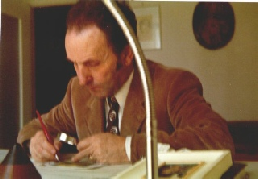
Guerino Casella, a miniaturist and surreal figurative painter, was born in the small village of Roncole Verdi di Busseto the tenth of February 1916. His childhood was very “painful”, as he used to describe his life. He was born during World War I. He never met his mother and was taken to an orphanage in Parma from where he was adopted at an early age by a family of Montechiarugolo. The family gave him the surname of Fatalcini but soon they brought him back to the same orphanage for trivial reasons. Later he was adopted again by a very modest family who raised him with love and legally recognised him by giving him their own surname: Casella.
From an early age he showed great passion for the arts, he used to read in the newspaper all the articles related to arts in general and to painting in particular. He used to cut out newspapers’ articles and he kept them in order to study them later, since the financial means to buy art books were very scarce. This passion for the arts led him to study on his own and eventually he obtained the Diploma with honours from the Liceo d’arte “Istituto Toschi” of Parma.
He returned home from World War II and he lived in Brescello until 1970. Here he met Ligabue Gualtieri, the most famous painter of that time. Then he moved to Parma until his death the third of August 2008.
He found the inspiration for his paintings in the worst places: in the German concentration camps, where he was interned until the day of the Liberation by the Allies. Casella made a virtue out of necessity: thanks to his talent he managed to survive in those terrible conditions. He was also able to help his fellow prisoners by painting portraits of German officers and their families in exchange for food and objects such as wallets or bags which he sent to his wife, Rina, as we can read in his letters to her. In this correspondence, the identity of the sender is: Casella Guerino, prisoner number 18898, camp designation 3./Bau-
Casella made his first painting exhibition in 1957, when he was 41. This long silence was due to different reasons: the long period of military service, the premature loss of a new-
Casella takes us back in that period, the fourteenth century, when the hardworking and patient art of writing and illuminating the codes and the painting in small sizes was an usual custom. Nowadays this form of art is no longer practiced and that gives to Casella's works a really important, unique, and unrepeatable value. These precious jewels of art are equal to the jewels commonly known.
In his long career as a miniaturist Casella participated in many competitions, set up several personal exhibitions in the most important Italian cities, such as Florence, Milan, Venice and also abroad, such as Innsbruck. Everywhere he received critics and public acclaim, although part of the critics objected to consider this form of art the same way as the official one (the art of the large paintings), indeed some critic did not even consider it a form of art at all, due to its small dimensions.
Many of his works are dispersed in the world in private and public collections. Those here exhibited are the few available, for the lovers of beauty.
During his life, Casella has come in contact with many famous personalities who made the history of that period, such as the President of the Republic Luigi Einaudi, J.F. Kennedy, Pope John XXIII, the senator for life Giulio Andreotti, artists such as Giorgio De Chirico, Cesare Zavattini, and so on; although he always kept bounded to his values of simplicity.
His scarce fame is mostly due to his shy and mystically solitary character, but very industrious nature when creating new miniatures: he devoted more time to his talent than his fame and always had lack of funds to set up exhibitions. When he came back from the war he took on the responsibility of a family of four, so his time was more committed to financially support his family with enormous and sometimes even humiliating sacrifices, than it was committed to paint miniatures.
In the latter part of his life he did not appear in public, convinced that what he had created was not sufficiently appreciated.
Magazines and Newspaper have been interested in his artwork, also the radio and the television have repeatedly broadcast services on his work.
As an artist, he did not disdain painting on canvas, improvising sketches in charcoal to imprint a particular moment or expression, and also working on some sculpture’s projects in beeswax, which still are well preserved. Miniature works, the main theme of his artistic life, were defined by the critics of his time "patient and meticulous artwork that finds its greatest exponent in Casella". His boards bring us back into the world of Brugel and the Flemish, and that of Salvador Dalì and De Chirico. The artist makes the right synthesis, he draws from these masters great lessons and stimuli to interpret with archaic and deeply progressive symbols the real dimensions of our present.
In a cultured, sophisticated, and refined re-
Biografy